
A talk I gave a few years ago to colleagues in the School of Law at Western Sydney University. Each section uses a quote from Stuart Hall’s ‘Teaching Race’.
On 30 April 1980, Stuart Hall gave a talk to the London Branch of the Association of Teachers of Social Science about ‘Teaching Race’. I am going to use the structure of Hall’s talk to think through my own practice of teaching race and the broader issues provoked.
This is not safe, but combustible material you are dealing with.
Teaching Race (Stuart Hall, Selected Writings on Race and Difference: p. 134)
This has motivated and guided my entire approach to working with and against race:
Instead of thinking that the questions of race are some sort of moral duty, moral intellectual academic duty which white people with good feelings do for blacks, one has to remember that the issue of race provides one of the most important ways of understanding how this society actually works and how it has arrived where it is. It is one of the most important keys, not into the margins of the society, but right into its dynamic centre (p. 135)
- ‘It’s not a topic where an academic or intellectual neutrality is of much value’ (p. 124).
Race is not a matter on which it is possible to be neutral.
Stuart Hall writes that people have strong emotional attachments to issues of race and there is no point in shying away from that. There is no point in trying to pretend that you don’t have a position on it. Nevertheless, you have to find a way to ‘create an atmosphere which allows people to say unpopular things.’ Hall doesn’t think there is any point in creating a classroom atmosphere which is so ‘unmistakably antiracist’ that people’s common-sense ideas have no room to emerge. It is better to air these ideas in an atmosphere of openness and honesty than to have them pushed under the rug.
The skill of enabling such an atmosphere is an extremely sophisticated one and a lot will depend on the level of experience of the educator, on who is in the room, and on the context of the discussion. There is a difference between allowing difficult ideas to be discussed and to create a false equivalence between racist and antiracist ideas. We must be able to work out our ideas in an atmosphere of mutual respect but not to allow racism to become a matter for debatability.
2. How I introduce my approach to students.
Teaching strategies which engage people’s most obvious, uncomplicated, unreflexive apprehension of the problem are important, but if having engaged them at that level you try to change attitudes and prejudices by putting good attitudes and prejudices against them, what you get is a kind of “ding-dong” effect of: “Well you believe that and I believe this, you see it that way and I see it this way,” and it becomes extremely difficult to move on in any productive way (p. 127).
Hall already recognised the problem of bothsidesism in 1980, but this has intensified in the intervening years. The problem is made more acute by a baseline of racial illiteracy within which facts about what Miri Song calls racism’s ‘history, severity and power’ are immaterial to the discussion.
Part of the problem with allowing discussions of race to turn into spectacles of debatability is that it treats race not as a topic of serious discussion but as something that exists merely in the realm of morality and gut feelings.
I developed the ‘Talking about racism bingo’ to engage this topic.
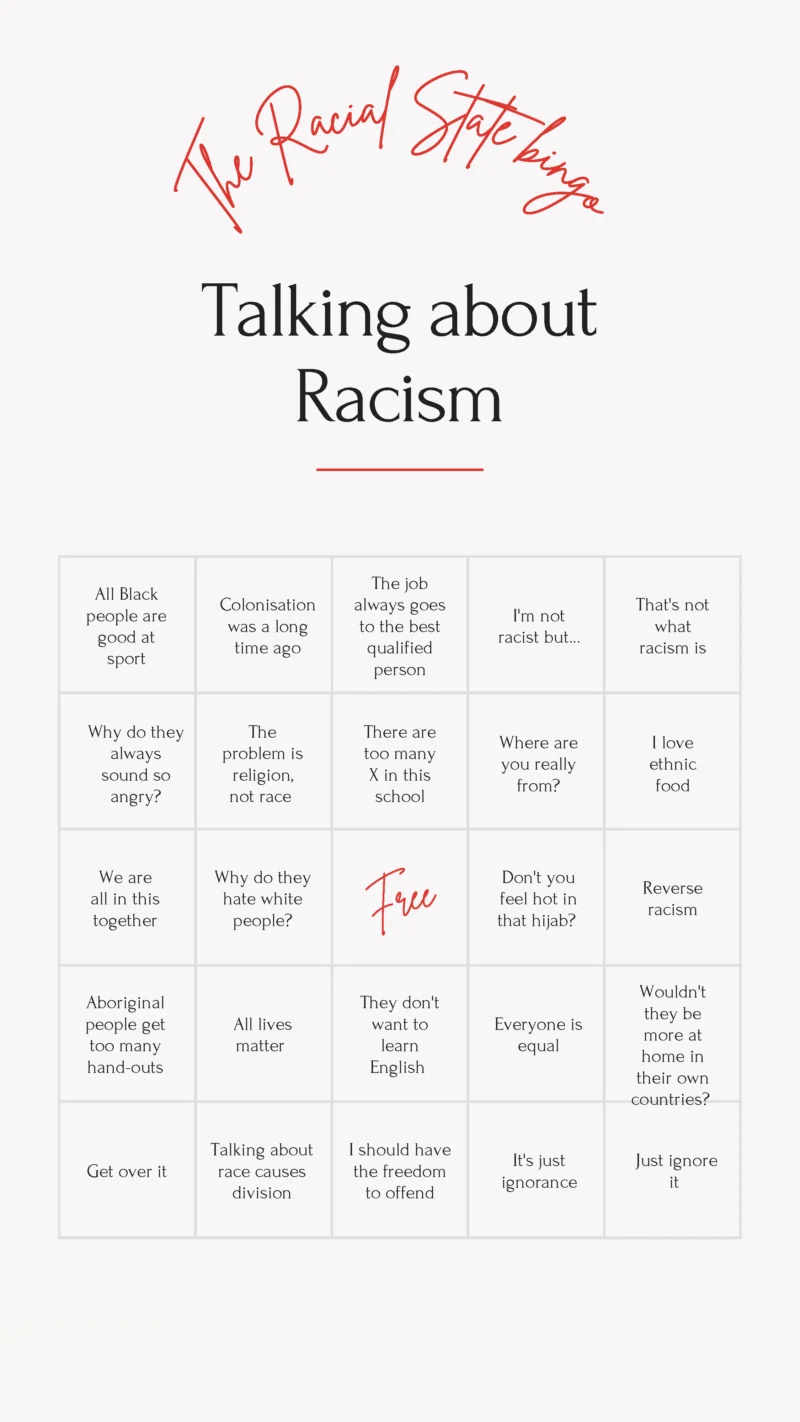
One of the techniques I have used in the classroom, is to recognise that race is often a subject for argument and debate, and to think creatively with students about how they can respond within social or family settings, using their learned knowledge.
How do you engage debatability in your classroom?
3. ‘There is a kind of liberal common-sense way of approaching the topic which fastens onto questions of discriminatory attitudes between people from different ethnic populations, prejudicial actions, beliefs and opinions, etc.’ (p. 126)
The problem in structuring discussions of race is not allowing them to dissolve into questions of interpersonal attitudes which is the dominant framing for discussions of race, particularly in Australia.
We need to talk about the fact that this is not true only in the public sphere, but also in most research where structural conditions are separated from what Hall calls ‘discriminatory attitudes.’ Many mainstream studies of racism in the social sciences treat it as a matter of discrete practices of discrimination disaggregated from the structural conditions of race in a settler colonial context.
As Hall notes, social psychology is often the driving explanation. The problem with framing racism in this way is that, while it may account to some extent for how racism can be psychically ingrained (we cannot discount the psychological as well as the visceral; As many Black studies scholars in particular have shown, there is a level of enjoyment to racist violence which is undeniable). However, grounding racism in the realm of individual morality does not account for the origins of race nor for its material basis (which I will look at further later on…)
Rather we get a view of racism that naturalises and pathologises it. By such accounts, racism is portrayed as something which is first and foremost a matter of individual attitudes, the implication being that we can either legislate or educate it ‘out’.
In Covid particularly we saw a rise in the treatment of racism as a psychopathology by analogy with the pandemic (Racism is a virus / racism is a pandemic).
I discussed this with my students using a short tiktok video I created building on Fanon’s classic essay, Racism and Culture.
As Hall says, rather than privileging social psychological explanations of racism, we should look at the structures that ‘generate particular kinds of relations, particular kinds of structures.’
How do we introduce the structural into our teaching in ways that go beyond increasingly empty invocations of ‘structural’, ‘systemic’ or ‘institutional’ racism (the differences between which are poorly understood)? When we have a situation in which even Joe Biden has been able to state that systemic racism exists while continuing to enact it through a variety of policies and practices, then we need tools to sharpen students’ understanding of how racism is practiced within institutions and how it is produced and reproduced systemically via a range of ideological discourses (the nation, multiculturalism, security, etc.).
My definition of race as a technology for the management of human difference, from my 2020 book Why Race Still Matters sets the terms of reference from the start.
There are two levels of teaching on race as a technology:
Postgraduate: Teaching about race as a technology using the work of Falguni Sheth, Wendy Chun and Charles Mills as explained in this blogpost.
Undergraduate: Institutional racism scenarios tutorial activity.
4. ‘One of the curious paradoxes about the area is that people know very simply how they feel and where they stand but when it comes to explaining the phenomena… it becomes a great deal more complex because it requires putting together explanations from different areas of knowledge.’ (p. 124)
One of the enormous challenges of teaching race is the lack of preparedness that I encounter. As Aileen Moreton-Robinson recounted during the panel we organised at the Institute for Culture and Society in September 2021 on critical race studies in Australia, race is sidelined as a topic of study and research in Australian higher education. Because race is not an area of consistent and sustained study, students often do not come skilled with the necessary background for a deep engagement. While they have the experience of racism, the dominant message of celebratory multiculturalism and the lack of critical analytical tools developed in earlier years, often leads to conversations about race which reproduces individualist and psychological accounts.
However, it is debatable whether race should be treated as a stand-alone subject, or whether it should be integrated throughout the curriculum (at present we have neither scenario). As Hall says, ‘I am very much opposed to constituting this as a kind of specialist area of social science – the “race relations problem” as it were’ because, as he argues, one only starts to see the full extent of the issue once race is seen in terms of ‘the different institutions, processes, and practices of whole societies’ (p. 125).
We have not been very good at integrating theorisations of race into the whole curriculum, rather than as discrete topics within general courses (i.e. a week on race…). The problem relates to the dominant tendency of seeing race as a set of discrete practices, as mentioned earlier with regards to the lens of discrimination. The challenge is an epistemic one – how to reorient our teaching in ways that enable race to be seen from a multidisciplinary perspective as well as being articulated with other processes of dominance.
There is much talk about mainstreaming within curricular discussions, but this can also come at the cost of expertise. We have a vicious circle type situation wherein the undervaluing of race as an area of research and pedagogy leads to a lack of capacity in the complex work of integrating race perspectives into the general curriculum (be it in Humanities and Social Sciences, or indeed in medicine, law, science, etc.).
Allied to this is the current focus in decolonising or Indigenising the curriculum which, while positive in comparison to the almost complete rejection of this in the not so distant past, nonetheless runs the risk in its present form of a culturalising approach which paints out anticolonialism, land back, reparations, self-determination, and the racial-colonial linkages between Indigenous survival and resistance and that of present and former colonised peoples around the globe (see Fredericks and Bargallie’s critique of cultural competency and Moreton-Robinson’s longstanding critique of the cultural entrapment of Indigeneity and the sidelining of race-centred Indigenous analysis).
Depoliticising decolonisation means coopting and taming it, a process that has already been seen with diversity, identity politics, and intersectionality once they have been whitened.
Integrating race as a topic of study throughout the curriculum is therefore sperate from the decolonising/Indigenising agenda as it’s presently been conceived. The latter has a limited amount of institutional support (for the moment – but let’s not hold our breaths) while race work has almost zero commitment. While Indigenous studies cannot and must not be reduced to studies of race, it is also important to recognise the effort made in deracialising Indigenous scholarship, in the sense of detaching it from the analytical power of a race critical lens, as Moreton-Robinson shows.
In an article for Current Sociology, Debbie Bargallie and I proposed to bring an Indigenist perspective from Critical Indigenous Studies together with a Critical Race analytics/toolbox in a theoretical synergy, as argued by Ali Meghji.
How do we open spaces for radical pedagogies that resist institutional capture?
5. ‘…to try to explain phenomena in this area one has to look at the relations or articulations between two things.’ (p. 125)
Hall’s insists on the need not to cloister race within its own intellectual cul de sac because, in order to understand it in its full complexity, we need to look at the articulation between two (or more) things. Hall’s discussion of articulation in relation to the link between class and race is the subject of his classic 1980 paper, ‘Race, Articulation and Societies Structured in Dominance‘.
Hall uses the methodological tool of articulation to think about how while two things may appear to be very close, they are not the same and cannot be reduced to each other, the classic case in point being class and race. In Race, Articulation and Societies Structured in Dominance, Hall explains that ‘race is the modality in which class is lived’, meaning that Black people in Britain (as per his example) experience labour relations through their experience as negatively racialised subjects. The problem for left politics, at his time of writing, and in different ways today, is that the mechanisms of how class and race connect to each other is not well understood. Hall recognised this when he wrote about the tendency to collapse race into the supra-category of class.
Hall calls for the articulation between race and class to be looked at in their different social formations; in other words, it is important to be specific and not to fall back on theories that generalise or that apply the particular conditions of one context to that of another. In Australia, a major problem in that regard is posed by the tendency to mobilise analyses generated in the US and apply them to the local context. This leads to local racial formations being relativised or subsumed under a framework that constitutes the US as the main source of both race and antiracism.
A failure to carefully articulate race, class, gender, ability, sexuality as axes of domination leads dangerously towards the reduction of their constitutive nature into a watery soup of diversity. The popularisation of intersectionality theory is a good example of an extrapolation that – in practice – has created more problems than it has resolved. Intersectionality, as theorised by Kimberle Crenshaw, is (a) specific to the US legal context and (b) has been misinterpreted as a way of conceptualising cross-cutting identities, leaving it open to cooptation and watering down, as argued by Sirma Bilge.
The other part of the story is the lack of real novelty of the idea, which has its unacknowledged roots in the work of Trinidadian organiser and writer Claudia Jones. I use Jones’ work on the triple oppression faced by Black women, as women, as Black and as workers across all my subjects because her work – particularly her 1949 essay, ‘An End to the Neglect of the Problems of the Negro Woman!’ – allows us to see in detail exactly how race, class and gender articulate, not as identities but as axes of domination.
Jones’ work and that of other Black feminists such as Patricia Hill Collins for example, can then in turn be articulated and complexified with Aileen Moreton-Robinson’s Aboriginal woman’s standpoint theory which goes beyond the body/earth split posited in non-Indigenous scholarship.
In practical terms, in the classroom, we can call on students’ and their families’ experiences as workers (many of whom are negatively racialised) to discuss the many ways in which class, race and gender are articulated. See teaching resources I have developed on this here, here, here, here and here.
A useful tool for thinking through this is service work/hospitality work/retail work, which many students are engaged in. Francoise Verges’ work on ‘caring for and cleaning the world’ which brings the focus on the work done mainly by women of colour, many of whom have no regularised migration status, in social reproduction makes this very concrete. We can all ask ourselves where we stand in relation to this work; what side of it we are on – as carers/cleaners/servicers or as recipients of the benefit of that work. As university staff/students, we can ask ourselves about the role of cleaners, security personnel, caterers etc. in keeping the campuses going often on precarious contracts, etc.
6. ‘…if you present a kind of idealised picture which doesn’t look at the way in which racism has combined itself with, for example, sexism working black within the black population itself, if you try to tell the story as if somewhere around the corner some whole constituted class is waiting for a green light to advance and displace the racist enemy and constitute a nonracist society, you will have done absolutely nothing whatsoever for the political understanding of your students.’ (p. 134)
There are a few things going on in this quote.
First, by talking about the importance of looking at how racism articulates with sexism (including within the Black community), Hall is warning against advancing any idealist positions in which there are simplistic good and bad actors; groups that are the villains and those who are pure victims. Not only does this reify whole groups of people, but it also leaves no avenue for resistance, leading students to have a teleological understanding of racism (and sexism) which is bound to repeat across the ages.
This is an ahistorical perspective which does nothing to increase understanding. It also opens the door to ideas such as ‘reverse’ or anti-white racism which disconnects race from the conditions of its production and reproduction, most prominently within colonial contexts.
Returning race to its bases, while being alive to its adaptability means using a decolonial analytics that can help students understand the global function of racializing power.
In practical terms, I use the Unsettled Exhibition to explore both Australia’s failure to relate to colonialism historically or as an ongoing set of practices. This is a cornerstone of assessment for Politics, Power and Resistance (the major emphasis being on how Indigenous people have and continue to resist invasion).
The second part of Hall’s quote relates to antiracism. Here we have to work together to think about a) the horizon of possibility that we are working through with students. We can ask questions such as what are they involved in, what are their experiences, what are the small ways in which they think change can come about. This is in order to move students away from falling back on empty signifiers such as ‘equality’ or ‘democracy’ or ‘multiculturalism’ that are both untheorized (what do we mean?) but also are difficult to translate into concrete examples (what would this really look like in your own life?).
We can use abolitionism, and especially the idea of small, incremental acts, to instil an understanding that everyone can be involved in ‘changing everything’ – that it starts with challenging our own carceral mindsets, instilled in us by society, home and school, and shift our behaviours in everyday contexts (e.g. how we relate to children, friends, neighbours, etc.). We can then build on the work of abolitionist activists such as Tabitha Lean, Sisters Inside, Sisters Uncut, Mariame Kaba in order to start joining analysis of systemic racism and reparative justice. See my teaching resources here, here, and here.
Through this, we can strongly oppose nihilist, antifuturist approaches which cut the possibilities for radical hope off at the knees. As Mariame Kaba says, ‘hope is a discipline’. We don’t serve our students by comforting them with liberalism, but neither do we contribute anything by offering no alternatives.
Thus, I turn to a whole range of radical thinkers and revolutionaries, including (non-exhaustively): The Black Panthers, George Jackson, Walter Rodney, Claudia Jones, Gary Foley, the Aboriginal Tent Embassy/Aboriginal Black Power, William Cooper, Selma James.
I also insist on the importance of harnessing a whole range of non-academic resources from reading lists, podcasts, blogs and social media (which raises issues of citation which we can discuss). In that vein, I also created a graphic essay based on my research on ‘not racism’.
I don’t believe in gatekeeping pedagogical materials and so everything is freely available on my website and is free to use.