

I was touched to have been awarded the School of Humanities and Communication Arts Researcher of the Year award 2020 at my institution, Western Sydney University. The prize was awarded for the paper, ‘Looking As White: anti-racism apps, appearance and racialized embodiment’, published in the journal Identities, and soon in…
170 CommentsTag: Australia

Debbie Bargallie and myself wrote an article for Croakey magazine on the need for racial literacy in Australian schools. Against the backdrop of a relentless pandemic and Black protest around the Global North, racial literacy is urgent. Bestseller lists and bookshop display tables are stacked high with volumes promising answers…
170 Comments
I am delighted to be working with Dr Zuleyka Zevallos on a new project – a web series of conversations about race and racism in Australia from a sociological perspective. Our first season deals with the theme of ‘Race and Covid’ can can be found on our YouTube channel. The…
170 Comments
I was invited to participate in a televised conversation on Racism and Antiracism by Afaf Belhouchet, the host of a programmed titled Geopolitix on Algeria channel Canal Algerie. My fellow panellists were Françoise Vergès, Nacira Guénif-Souilamas, and Brahim Oumansour. It was great honour for me to be able to share some…
170 Comments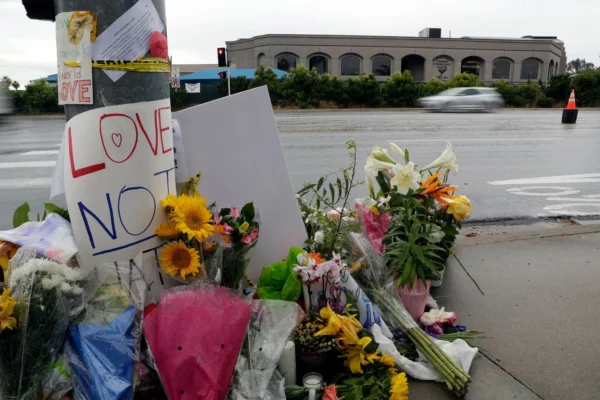
I chatted to the excellent people at Radio 3CR Tuesday Breakfast on April 30 about the rise of white supremacism in Australia and elsewhere following the antisemitic, white supremacist attack on the Chabad of Poway synagogue in San Diego which resulted in one death on April 27. I also answered questions…
170 Comments
I was asked to write an article for The Guardian about the horrendous racist cartoon of Serena Williams drawn by Australian cartoonist Mark Knight. Unfortunately, the headline used the word ‘ignorance’ which led some people to rightly point out that the problems of racism in Australia, or elsewhere, has nothing…
170 Comments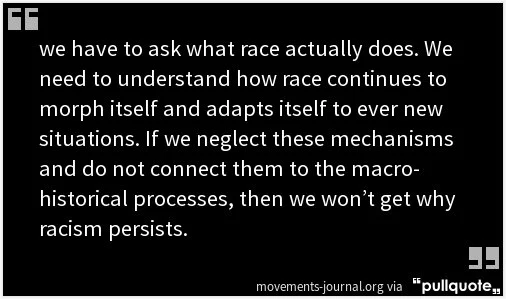
I was delighted to be interviewed for the latest issue of the German Journal für kritische Migrations- und Grenzregimeforschung by Juliane Karakayali. Claudia Garcia-Rojas (@ClaudiaStellar) was kind enough to create this quote from the interview which you can read here. Save
170 CommentsOn Monday June 20 I was interviewed by Raymond Grenfell on Indymedia on RTR FM (Perth) about the assassination of Jo Cox, the far right and racism in Britain and Australia. You can listen again here. I tried to talk about how mainstream politics nurtures the environment in which Jo…
170 Comments
Since I wrote this post I have had much time to reflect on the critique of it made by Angela Mitropoulos on her website. It is no defence that I wrote the original blogpost in a hurry and that I failed to reference the three articles linked to in the postscript or her own longstanding work on the subject, for example (but not exhaustively) here, here and here. It has also caused me to reflect on how to better represent the underpinnings of the knowledge I have gained in my work, and to avoid formulations that give the impression that they originated with me, or only with a selective literature.
As I tell my students, which of course is a well-founded antiracist principle that I did not invent, intentions don’t mean a thing. I cannot erase past mistakes, I can only strive to do better.
In an attempt to do so, I have left most of the post intact so that I do not create an impression after the fact that it was better than it was, but I have inserted references that I hope show the trajectory of the development of my thought, and might go some small and modest way towards redress.
Postscript March 1, 2016:
Always happy to be set right, it has been pointed out that when I hastily wrote the below on February 8, I omitted to reference three important articles which preceded my thinking here. These are “To Hell With Progressive Intentions” by Wenny, “Why Were Most Of The Anti-Reclaim Protesters White?” by Sanmati Verma, and “GetUp and the Amazing Disappearing of Women of Colour” Ardhra. It also adds to my own thoughts in response to this statement by Liz Thompson developed here in 2014.
I would also like to add that since I wrote this, further crucial reflections were added to the general topics by Carolina Lee, Ahmed, Sanmati, Tom, Matt, Liz and Angela Mitropoulos in this Roundtable discussion.
…
Here is the original post with inserted references in red.
I’ve been going at this question of what race does for the last few years. I’ve mainly been thinking about the question in relation to Barnor Hesse’s crucial explanation of the performativity of race which he explains in a fantastic lecture which can be watched below.
I’ve tried to explain some of the ways I have taken up those ideas in my recent work, a response to Michael Banton called What Does Race Do? and an article on Racism in Public or Public Racism, as well as my response to Karim Murji and John Solomos’s book, Theories of Race and Ethnicity (these are all available on my Academia page should they be behind a paywall).
At the moment, I am finishing off an unwieldy paper with the working title, ‘Not Doing Race in Australia’, on the absence of race in much Australian racism studies (to distinguish them from race critical or decolonial approaches). My focus is on the work that gets the big grants. (Ironically, given that I have recently been led to understand that neither writing these sorts of blog posts, collaborating with other scholars, or doing any form of activism or public engagement, despite the hype, gains one any institutional recognition of the value of your work, I should probably taking a leaf out of their book and use this time to apply for some research funding, but that is a topic for another day!).
170 CommentsIn my first article on racism and antiracism in Australia, published online first in Ethnic and Racial Studies and part of a special issue on ‘Reconfiguring Antiracisms’ edited by Yin Paradies, I argue that The idea of racism as an event appears crucial to the judgment of its legitimacy. By…
170 Comments
The Case for Open Borders
This article was originally published in Overland on August 5, 2013. Underlying Bernard Keane’s article – ‘“Let them all come” is “stop the boats” for progressives’ – is a deep sense of indignation about the idea that Australians are racist. The oft-repeated argument is that elitist, disconnected, latte-sippers tut-tut over…