

I was invited by Franck Magennis and Fahad Ansari of Riverway to the Sea to contribute to an event held on December 9 2025, ‘Is Zionism fascist? What will judges think? Here are the slides from my short presentation which focused on how the Black radical tradition helps us to…
Comments closedTag: C.L.R. James

Alexander Weheliye’s 2014 book, Habeas Viscus is a vital critique of two dominant accounts of the limits and contours of humanity: Michel Foucault’s biopolitics and Giorgio Agamben’s bare life. But beyond providing us with a much needed problematisation of these two theories, what they omit, and the Eurocentrisms they reproduce, this book offers much more. In fact, despite the book’s framing around the critique of bare life and biopolitics, Habeas Viscus in my reading is really a call to see race – and thus the concept of the human – otherwise and a rallying call for Black thought and its centrality for making sense of modernity. Alexander Weheliye, a professor of African-American studies, is primarily a cultural-literary theorist/philosopher. His points of reference and his lyrical, evocative but dense writing style are harder for sociologists to access. Nevertheless, his insistence on placing Black feminist thought at the heart of this theorization of race, the human and the ‘possibilities of other worlds’ (Weheliye 2014: 2) means that there is a lot that race critical students interested in the function of race but also the constant possibility of self-emancipation in the face of its structuring constraints can learn from his groundbreaking book.
Comments closed
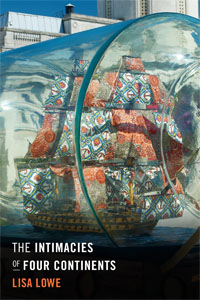 Lisa Lowe‘s 2015 book, The Intimacies of Four Continents, is the impetus for this week’s blog, the fifth in my Race Critical and Decolonial Sociology series. This groundbreaking work challenges us to unread standard accounts of the development of capitalist modernity and political liberalism. It does not do this only by inserting race, gender and the colonial in order to disrupt these standard accounts. While this work is vital, Lisa Lowe goes several steps further. She reorients official histories by reading the archives against each other and juxtaposes this archaeological work with an unreading of standard texts from literature, autobiography and political philosophy. The Intimacies of Four Continents is not the kind of book that sociologists are used to reading, but neither is it a standard work of history, literature or philosophy as it is profoundly interdisciplinary. The book is an example par excellence of what a relational, interactive or connected account looks like, taking us several steps deeper into the discussion, begun in blogs 3 and 4, about the methodological and epistemological challenges of doing sociology with a truly global orientation.
The Intimacies of Four Continents contains so many multiple layers and such a rich account of interrelated histories that I will be unable to do it justice in its entirety here. I wish instead to focus on three aspects of the book: 1) its methodological contribution, which provides a concrete example of what a truly connected scholarship looks like; 2) most significantly for me, its emplacement of race squarely within liberalism; and 3) its insistence on the impossibility of separating an antiracist, anticolonial praxis from these histories and the consequent scholarship. This third point allows me to build on my comments regarding Du Bois’ activism, begun in my last blog, as Lowe uses Du Bois and C.L.R. James’ work as exemplars of what such active scholarship looks like.
Comments closed