This post has had to have been updated to another death of a young man – a victim of state racism leading directly to the neglect of his health and ultimately the loss of his life – on Nauru on May 11 2016. Rakib – from Bangladesh, died of multiple…
Text of pamphlet distributed at meeting of Australian Council of Superannuation investors annual conference, Melbourne, 10th May 2016.
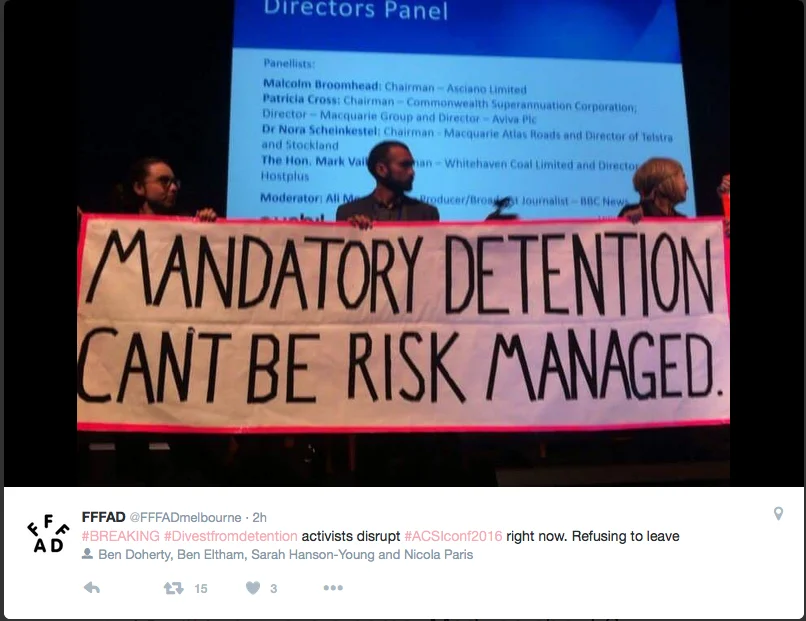
This morning, 10th May 2016, the Divest from Detention network has targeted the annual conference of the Australian Council of Superannuation Investors (ACSI) in Melbourne:
Mandatory detention cannot be risk managed: close the camps
In August 2015, in the wake of HESTA’s decision to divest from Transfield, it was reported that ACSI was “seeking more information” on the situation in the Manus and Nauru detention camps. Just in case ACSI and its member funds haven’t noticed, people are still being raped, illegally detained, tortured and are still dying on Manus and Nauru, all on the dime of some of Australia’s largest super funds. Compensation for illegal detention on Manus Island is likely to run into the millions if not billions.
My thanks to Michael Richmond of The Occupied Times of London for publishing this short comment on frozen racism, the European abuse of Holocaust memorialisation and the denial of coloniality in the current ‘crisisification’ of the arrival of refugees in Europe. The whole issue is on race with articles by…
On March 8 2016, Michael Pezzullo, Secretary of the Australian Department of Immigration and Border Protection, was moved to issue a press release. He felt compelled to defend the actions of his department against criticisms of what he called a ‘contentious area of public policy and administration’, the mandatory and indefinite detention of asylum seeker children. Critics on social media rushed to point out that the most telling part of Pezzullo’s statement was his comment that,
Recent comparisons of immigration detention centres to ‘gulags’; suggestions that detention involves a ‘public numbing and indifference’ similar to that allegedly experienced in Nazi Germany; and persistent suggestions that detention facilities are places of ‘torture’ are highly offensive, unwarranted and plainly wrong – and yet they continue to be made in some quarters
It was the use of the word ‘allegedly’ that raised the most ire; the statement had made it sound like the DIBP was denying the magnitude of the Holocaust. Pezzullo followed up with another release:
Any insinuation the Department denies the atrocities committed in Nazi Germany are both ridiculous and baseless… The term ‘allegedly’ was used to counter claims of ‘public numbing and indifference’ towards state abuses in Nazi Germany and the link to immigration detention in Australia. We reject the comparison to immigration detention as offensive and question this being made as a blanket statement – an allegation hence ‘allegedly’ – to describe the attitude of the German population at large during that terrible time.
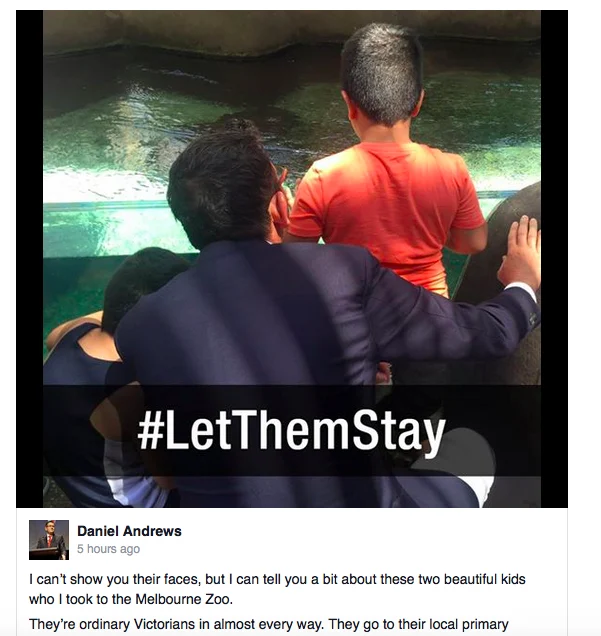
The Victorian Premier at the zoo with young asylum seekers
Since I wrote this post I have had much time to reflect on the critique of it made by Angela Mitropoulos on her website. It is no defence that I wrote the original blogpost in a hurry and that I failed to reference the three articles linked to in the postscript or her own longstanding work onthe subject, for example (but not exhaustively) here, here and here. It has also caused me to reflect on how to better represent the underpinnings of the knowledge I have gained in my work, and to avoid formulations that give the impression that they originated with me, or only with a selective literature.
As I tell my students, which of course is a well-founded antiracist principle that I did not invent, intentions don’t mean a thing. I cannot erase past mistakes, I can only strive to do better.
In an attempt to do so, I have left most of the post intact so that I do not create an impression after the fact that it was better than it was, but I have inserted references that I hope show the trajectory of the development of my thought, and might go some small and modest way towards redress.
I would also like to add that since I wrote this, further crucial reflections were added to the general topics by Carolina Lee, Ahmed, Sanmati, Tom, Matt, Liz and Angela Mitropoulos in this Roundtable discussion.
…
Here is the original post with inserted references in red.
I’ve been going at this question of what race does for the last few years. I’ve mainly been thinking about the question in relation to Barnor Hesse’s crucial explanation of the performativity of race which he explains in a fantastic lecture which can be watched below.
I’ve tried to explain some of the ways I have taken up those ideas in my recent work, a response to Michael Banton called What Does Race Do? and an article on Racism in Public or Public Racism, as well as my response to Karim Murji and John Solomos’s book, Theories of Race and Ethnicity (these are all available on my Academia page should they be behind a paywall).
At the moment, I am finishing off an unwieldy paper with the working title, ‘Not Doing Race in Australia’, on the absence of race in much Australian racism studies (to distinguish them from race critical or decolonial approaches). My focus is on the work that gets the big grants. (Ironically, given that I have recently been led to understand that neither writing these sorts of blog posts, collaborating with other scholars, or doing any form of activism or public engagement, despite the hype, gains one any institutional recognition of the value of your work, I should probably taking a leaf out of their book and use this time to apply for some research funding, but that is a topic for another day!).
On November 9, I published an article in The Guardian, co-written with Omar Bensaidi, on the liberal approach to racism in Australia. Racism denial is rife in Australia among white elites and those captured in the tentacles of what Jon Stratton termed ‘honorary whiteness’. The article argued that Standing back…
I was invited by Luqman Onikosi at Sussex University to address Black History Month, an event I used to enjoy immensely during my time there. I highlight for me was chairing the Black Panther speaking tour back in 2008. Luqman asked me to speak on the problematic separation between race, class and gender, and I’m not sure how much justice I did to that massive subject. However, the following text include some reflections on the question of what race is, the problematic misunderstanding of race in the approach taken by Lisa McKenzie in her recent Guardian article, ‘The Refugee crisis will hit the UK’s working class areas the hardest‘, and what I see as the blindness of the white left opposition to identity politics. Please note that these reflections are schematic and I might work it up into a longer article in due course.
I have published a short piece on Charlie Hebdo and antiracism, based on a longer chapter co-written with Gavan Titley, in Public Seminar. The attacks on the offices of the French satirical magazine, Charlie Hebdo and a kosher supermarket in January 2015, during which fourteen people were killed, pose a…
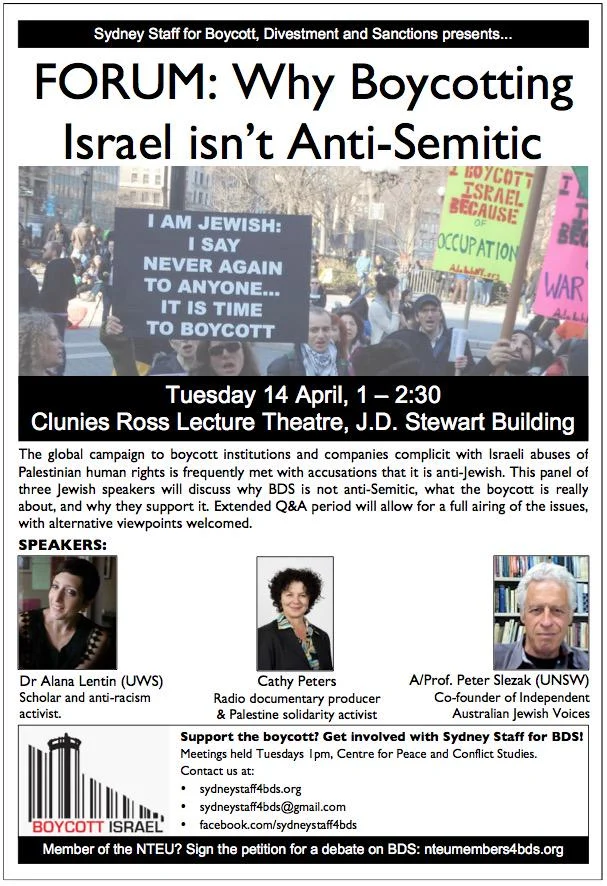
I was asked by Sydney Staff for BDS, a group at the University of Sydney, to join a panel on ‘Why it isn’t antisemitic to boycott Israel’ on April 14 2015. Below is the ext of my brief talk.
Hannah Arendt was lambasted for talking about the flip side of antisemitism: philosemitism.
But she understood that antisemitism in fact relies on the apparent love of Jews. Or put another way, philosemitism creates antisemitism.
Arendt was talking historically about the conditions leading up to the holocaust, but philosemitism is equally a problem today in the context of the role of Jews vis-a-vis the state of Israel.

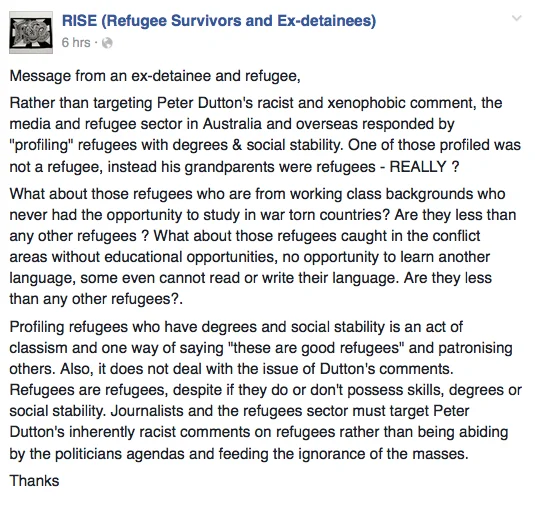
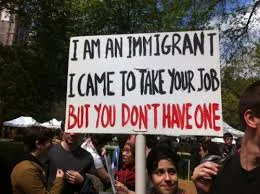 Two recent comments summarise the problem with responding to Australian Immigration Minister Peter Dutton’s base level Powellian dog-whistling racism with pictures of successful refugees.