Alana Lentin is a Professor in Cultural and Social Analysis at Western Sydney University. She is a Jewish woman who is a settler on Gadigal land. She works on the critical theorization of race, racism and antiracism.
She is a graduate of the European University Institute where she earned her PhD in political and social sciences in 2002, and the London School of Economics (1997). Prior to joining the School of Humanities and Communication Arts at Western Sydney University, she was a Senior Lecturer in the Department of Sociology at Sussex University (2006-2012). Before this she held a Marie Curie EC Research Fellowship at the Refugee Studies Centre at the University of Oxford (2003-2005). In 2017, she was the Hans Speier Visiting Professor of Sociology at the New School for Social Research in New York and has previously been a visiting scholar at the Institute for Cultural Inquiry in Berlin (2010).
She is co-editor of the Rowman and Littlefield International book series, Challenging Migration Studies (opens in new window)Opens in a new window and former President of the Australian Critical Race & Whiteness Studies Association (opens in new window)Opens in a new window (2017-20). She is on the editorial board of Ethnic and Racial Studies, Identities, Journal of Australian Studies, Critical Race and Whiteness Studies, and the Pluto Books series, Vagabonds.
Her current research examines the interplay between race and digital technology and social media. Her most recent research project analysed the use of ‘antiracism apps’ for education and intervention.
Her books include Why Race Still Matters (Polity 2020), The Crises of Multiculturalism: Racism in a neoliberal age (with Gavan Titley 2011), Racism and Sociology (2014 with Wulf D. Hund), Racism (2008) and racism and Anti-racism in Europe (2004). She has written for The Guardian, OpenDemocracy, ABC Religion and Ethics, The Conversation, Sociological Review and Public Seminar. She has been interviewed for The Minefield on ABC Radio National, local ABC radio, Japanese television and Korean radio among others. She teaches a Masters course, Understanding Race which is accompanied by a series of blogs and an open syllabus available at http://www.alanalentin.net/teaching/
This is the third contribution to the Race Critical and Decolonial Sociology blog series. In it I look at the argument advanced by David Theo Goldberg (2009) that a relational approach to the study of race and racism reveals more than a comparativist approach does. I propose, however, that before being able to discuss the relative adequacy of either approach, we must have a good understanding of what is being researched when we centre race in accounts of historical or contemporary social, political and economic processes.
I examined work by mainstream ‘migration, ethnicities and minorities’ (MEM) scholars in Europe. Through institutes and departments often aligned with policy-making, these scholars often receive the lion’s share of the funding to research issues which, from a race critical perspective, are wholly about race. Yet their work mainly tends to neglect, elide or even deny the salience of race. In my view there are three main reasons for this:
The second post in the Race Critical and Decolonial Sociology blog series is a round-up of some of the central debates in postcolonial and decolonial thinking about epistemology. The class had a very interesting discussion where for example the historicity of Ramon Grosfoguel’s timeline was interrogated. Students also tackled the thorny question, raised also by Arif Dirlik in his critique of postcolonial studies, about the validity of criticisms of imperialist or Eurocentric or what Boaventra De Sousa Santos calls ‘abyssal’ thought made by scholars who, while originating from the Global South (though not always) work at universities in the rich North, mainly the United States. We surmised that that this is a bind that we are essentially all mired it. However, that it is important to be aware of the real possibility for the coexistence of theorising and activism, thus not merely lauding the work of social movements in books and articles, but using any leverage we may have in the university to make space for them to represent themselves and to guide theory-making. This linked to the previous week’s discussion ‘Black Study, Black Struggle’ and the possibility of subverting the university to facilitate rather than thwart study in the socially transformative sense of the word.
What are the possibilities for social and political critique opened up by the decolonial approach.I shall examine the interconnections between postcolonial theory and the decolonial, uncovering the trajectory that began with Indian subaltern studies and Latin American autonomous social science, for example. I shall also examine the impact of a critical focus on race, gender and sexuality on the opening out of decolonial approaches. This work will go towards asking questions about the epistemological implications of taking a decolonial approach as well as examining the possibilities for transformative social and political action.
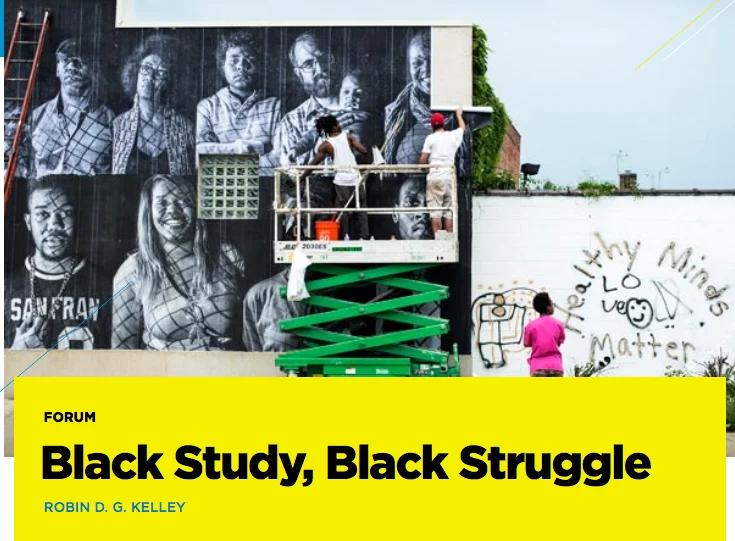
‘Black Study, Black Struggle’ by Robin D.G. Kelley
This is the first in a series of posts for my graduate course, Race Critical and Decolonial Sociology offered during my Hans Speier Visiting Professorship at The New School in New York (Spring 2017). See the syllabus here.
In Session 2, we discussed Robin D.G. Kelley’s article in The Boston Review and the responses to it from the perspective of the current challenges facing the United States and the world unleashed by the white supremacist Trump regime and asked what the role of the University could be from a race critical perspective.
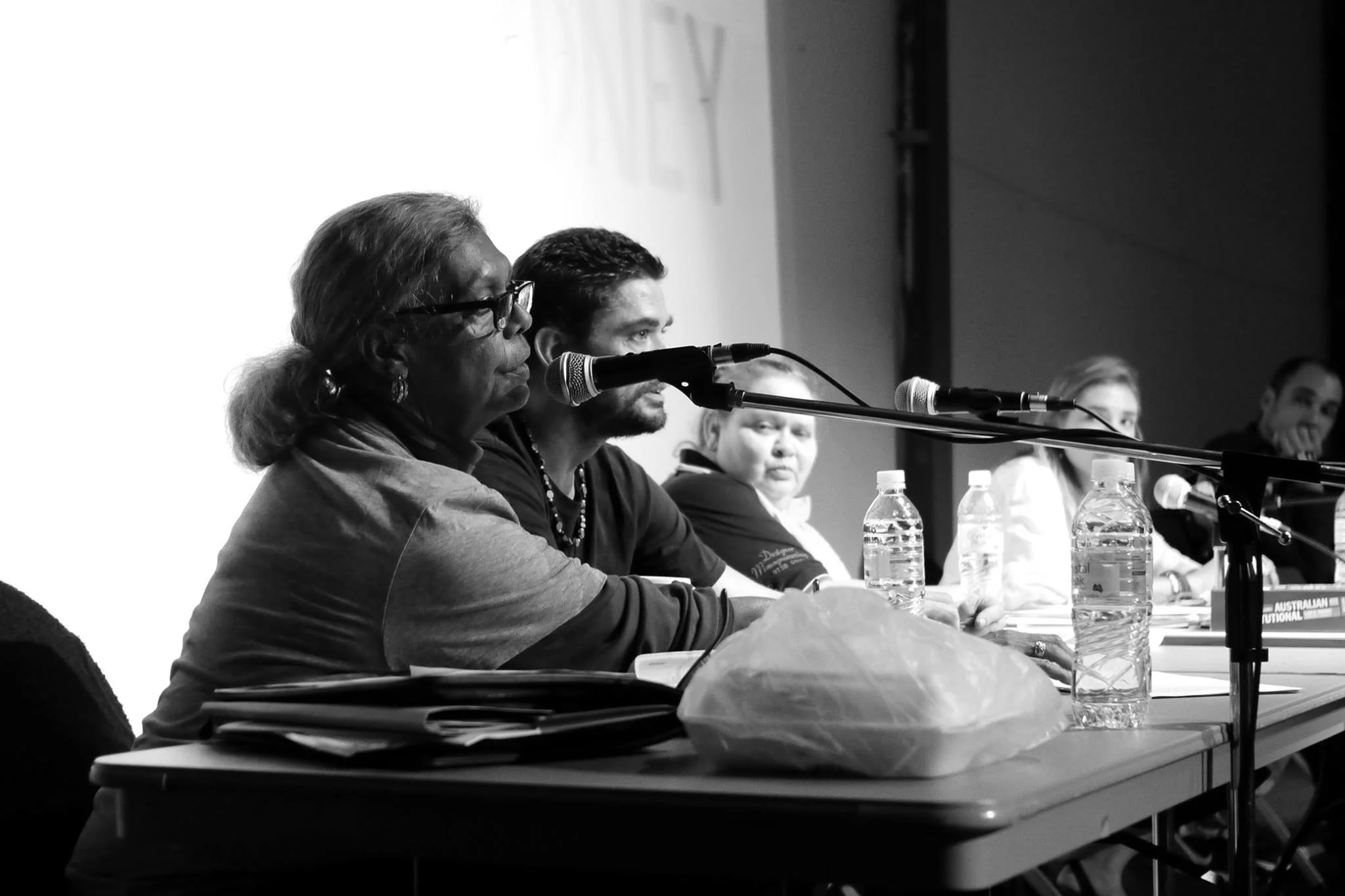
Jenny Munro and panelists at the launch of the Free University of Western Sydney. Photo by Adriana Abu Abara.
In April 2016, the Free University of Western Sydney was launched by a group of local people – activists, teachers/educators and students – critical of the neoliberal university’s capacity to be a site for free study. I was honoured to be in attendance at the launch event which purposefully was a panel discussion between Aboriginal activists to address ‘the foundation of Australia’s racist architecture to aid in the development of a collective understanding of racial oppression.’ The discussion addressed the truth that, just as white Australia was built on the systematic dispossession of Aboriginal land, people and culture, its knowledge structures, including those within the university, serve to perpetuate these dispossessions. As such, no learning within the university, no matter how radical in purpose or tone, can on its own dismantle the structures of domination on which the persistence of Australia as a white settler colony depend. To think of an example that is relevant in my own teaching, in the context of my undergraduate course at Western Sydney University, The Racial State, it is insufficient to critique attachments to ‘Australia Day’ often displayed by students or to question the frequently repeated misconceptions about Aboriginal people (e.g. all Aboriginal people are given university places above members of all other groups irrespective of their attainment) in a room where Aboriginal students are either absent or in an extreme minority. It is insufficient to acknowledge country or even welcome Aboriginal speakers into the classroom to (for example Aunty Jenny Munro who came to talk about the struggles of the Redfern Tent Embassy) without asking why I, a recent migrant to Australia, with a European Union passport, is teaching on the continuities of race and racism rather than any number of Aboriginal scholars.
Race Critical and decolonial sociology is premised on the idea that to understand politics in western modernity requires placing race and coloniality central to analyses. The course will therefore be grounded in political sociological, theoretical and historical sociological readings of race, racism, imperialism, colonialism, slavery, genocide, and immigration and borders…
This is a provisional syllabus for my undergraduate course at The New School, Spring 2017.
Overview of substantive topics
Part I: Roots
⊗ Situating race
⊗ What is race?
⊗ Race and experience
⊗ Race and state
⊗ Race and Europeanness
⊗ Race, settler colonialism, and Indigenous resistance
⊗ Slavery
⊗ Whiteness
⊗ Race, gender and sexuality
Part II: Continuities
⊗ Antiblackness
⊗ Race, criminalisation and incarceration
⊗ The return of antisemitism?
⊗ Islamophobia, securitisation and ‘the war on terror’
⊗ Borders and migrations
Part III: Urgencies
⊗ Are we postrace yet?
⊗ Re-emerging fascisms
⊗ Race, digital technologies and social media.
Justine Humphry and I have launched a new website for our work on digital antiracisms. Please visit to stay abreast of events, publications and other initiatives including the recent visit tp Sydney of Jessie Daniels, author of White Lies and Cyber Racism. Save
Race and embodiment in antiracism apps from Alana Lentin on Vimeo. I gave a talk at the 10th Somatechnics Conference – Technicity, Temporality, Embodiment – at Byron Bay, 1-3 December 2016 on the antiracism apps project I am co-researching with Justine Humphry. You can listen here.
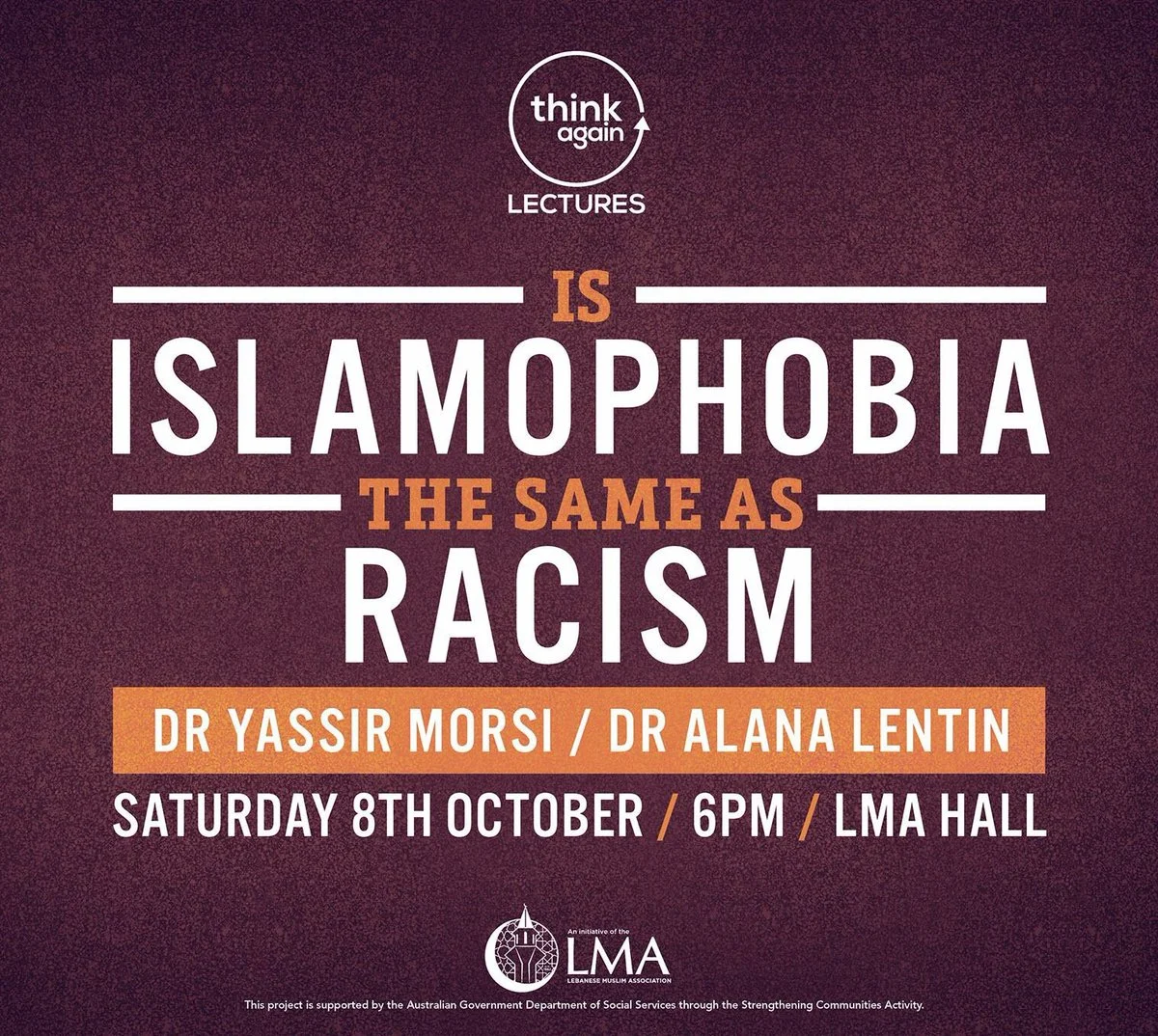
This Saturday, October 8th, I’ll be taking race and antiracism and the relationship between racism and Islamophobia with Yassir Morsi at the Lebanese Muslim Association. Save
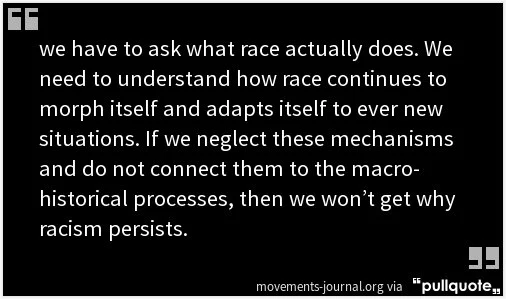
I was delighted to be interviewed for the latest issue of the German Journal für kritische Migrations- und Grenzregimeforschung by Juliane Karakayali. Claudia Garcia-Rojas (@ClaudiaStellar) was kind enough to create this quote from the interview which you can read here. Save
Work in Progress I didn’t know a baby could be a weapon And it took nearly 7 years to see what she represented When While idling on my phone I came across a mention Not of me (Though it could have been) Or so I felt Viscerally But wasn’t this…
Justine Humphry and I have just published an article at The Conversation on our research into antiracism apps. More details about this ongoing research can be found here. In the aftermath of Brexit in the UK and the success of Pauline Hanson in the Australian Senate elections, racism seems to…

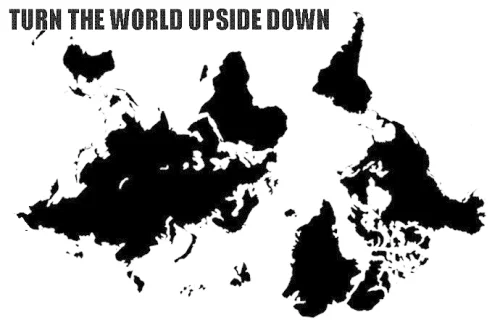
 The second post in the Race Critical and Decolonial Sociology blog series is a round-up of some of the central debates in postcolonial and decolonial thinking about epistemology. The class had a very interesting discussion where for example the historicity of Ramon Grosfoguel’s timeline was interrogated. Students also tackled the thorny question, raised also by Arif Dirlik in his critique of postcolonial studies, about the validity of criticisms of imperialist or Eurocentric or what Boaventra De Sousa Santos calls ‘abyssal’ thought made by scholars who, while originating from the Global South (though not always) work at universities in the rich North, mainly the United States. We surmised that that this is a bind that we are essentially all mired it. However, that it is important to be aware of the real possibility for the coexistence of theorising and activism, thus not merely lauding the work of social movements in books and articles, but using any leverage we may have in the university to make space for them to represent themselves and to guide theory-making. This linked to the previous week’s discussion ‘Black Study, Black Struggle’ and the possibility of subverting the university to facilitate rather than thwart study in the socially transformative sense of the word.